



Humanoid Robotics ETF: Why Physical AI Is Closer Than You Think – Insights from Autodiscovery
By Jack Patrick
The Physical AI Era Has Arrived
Aron Kisdi, Managing Director of Autodiscovery, a UK-based robotics company, is no stranger to innovative technology. He has spent 17 years in the industry, working for the European Space Agency, the UK government, and large multinational companies.
"I have been in robotics for my whole career – over 17 years now," Aron told us during a Q&A we recently hosted at Autodiscovery's UK headquarters near Oxford. "We worked on automation for future Mars exploration robots, as well as many applications of autonomous tech for underground mining, agriculture, and factory automation."
Our introduction to Aron was, fittingly, a logistical problem involving a robot. We were bringing a Unitree G1 over from New York for an event in London and couldn't import the spare battery we needed. So, we bought one from him instead. It was the kind of practical, no-fuss fix that turns out to be very on-brand for someone who has spent his whole career making advanced robotics actually work in the real world.
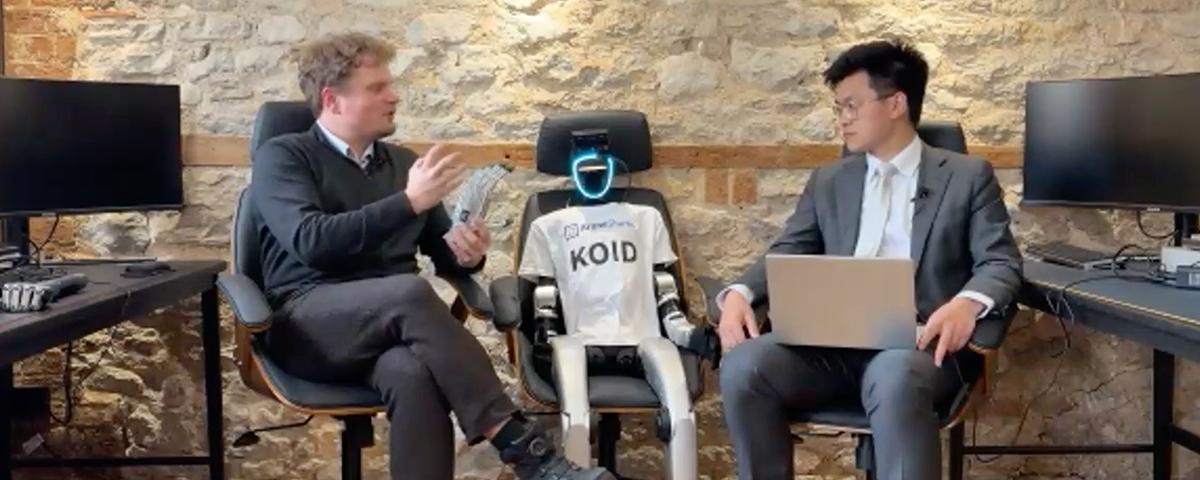
The conversation, hosted by KraneShares Senior Investment Strategist, Derek Yan, CFA, featured a live demonstration of the Unitree G1 humanoid robot alongside a wide-ranging discussion on where the industry is headed and how KOID, the KraneShares Global Humanoid & Embodied Intelligence Index UCITS ETF, is positioned to capture the global humanoid opportunity.
Below, we share expanded highlights from the webinar.
Why Humanoids, Why Now? Rapid Progress Meets Affordable Hardware
Aron set the tone by putting the current excitement around humanoid robotics into context. Five years ago, he launched Autodiscovery to address what he saw as a persistent gap between research-stage robots and real-world deployment.
The mission, in his words, is straightforward: "The reason for Autodiscovery is to enable more people to have robots, to own robots. We want to hand over the robot systems, train people up so they can use the robots themselves – and we see that this is very important for growing this market quickly."
The decisive shift, he explained, is affordability. Where a humanoid like NASA's Valkyrie once cost $1–2 million, the Unitree G1 EDU Plus now sits at approximately £30,000. This price point has unlocked access for universities, smaller companies, and a global wave of developers who are now driving the sector forward.
"Previously this hardware was only affordable to the most well-funded labs, and now it's in the range where labs and even small companies can think about buying one," Aron noted. "That has been a massive shift, and that's why suddenly a lot of people can work on these robots."
He highlighted Unitree's trajectory as emblematic of the industry at large. Comparing videos from the Chinese New Year Gala two years ago to this year's, the progress is striking. "That trajectory is really a characteristic of humanoid robots at this point," Aron said. "We are at the beginning of the journey and we're seeing very rapid progress and very rapid growth. The next year will be similarly impressive – leaps and bounds."
Hardware Is Ready. Software Must Catch Up.
A central theme of the webinar was the gap between where hardware capability stands today and where AI software intelligence needs to go. The Unitree G1 can already perform kung fu, flips, and martial arts movements that were impossible just two years ago. Yet, in commercial and industrial contexts, Aron was candid about what remains unsolved: "The barrier is more on the software side of the physical AI. That needs to be advanced, and part of the challenge is getting the data sets."
Bridging the software gap requires massive volumes of real-world robotics data, something that doesn't yet exist at the scale that internet data fuelled the large language model revolution. Aron outlined several approaches: direct teleoperation using VR headsets, high-quality simulation environments, and specialised data-collection platforms.
He described a compelling parallel to the AI scaling law dynamic – as more robots are deployed, more data is collected, accelerating the development of physical AI models. The ecosystem is on the cusp of a powerful feedback loop, but the data infrastructure needs to grow first.
He also pointed to a more immediate practical barrier: the way users interact with robots today. Making sure there is a natural, conversational interface, where a robot can receive a task, ask clarifying questions, and execute correctly, is, in his view, "currently a huge barrier to deploying robots to companies that don't have the technical expertise to use current user interfaces, but want a more natural engagement with the robot."
Industry Before Household: The Path to Mainstream Deployment
Aron was clear about sequencing. Industrial and commercial environments will see widespread humanoid deployment before homes do, because factories and warehouses allow for specialised, repeatable task training with measurable ROI. Households, by contrast, demand general-purpose intelligence capable of handling unpredictable environments, a harder problem likely five to six years away at scale.
Within industry, Aron highlighted sectors that often go overlooked in automation discussions: food production, energy (including solar, wind, and nuclear), retail, transportation, and agriculture. Crucially, he pushed back on the narrative of direct job replacement. "I don't see it as: here is a person, you replace them with a robot. I see it as: here is a person, you give them five robots, and now they are much more productive working together with those five robots."
He also described high-value one-off use cases that don't require continuous deployment: firefighting scenarios, handling equipment in hazardous conditions, and remotely operated units in secure facilities like server farms or nuclear plants. In each case, flying in an authorised specialist is expensive and slow, but logging into a local robot is not.
Teleoperation and the New Labour Paradigm
One of the most compelling near-term applications discussed was teleoperation, which involves using humanoid robots as physical proxies controlled remotely by human experts. Autodiscovery is already working with the European Space Agency on satellite-connected robot control, enabling a specialist anywhere in the world to operate a robot in a remote or restricted location in real time.
Aron illustrated the opportunity vividly: "If you are a domain expert in fixing a pump on an oil rig, you could be sitting at home directly controlling one of these robots in the middle of the sea and show the people there how to fix that equipment. And then, of course, we can collect that data and, in the future with these data sets building up, that task can be automated as domain expertise is recorded."
The longer-term vision extends well beyond one-to-one control. The trajectory Aron described moves from one operator per robot, to one operator managing five, then 100, then 500 simultaneously, mirroring the progression seen in drone fleet management. Achieving this requires not just smarter individual robots but genuine robot-to-robot communication: fleets that can coordinate tasks, request assistance, and self-organise. "We are starting our first project with seven robots working together where they need to talk to each other," Aron noted. "That's the beginning of a very fast-growing trajectory."
Dexterity: The Unsolved Frontier
A fascinating portion of the webinar focused on robotic hands, arguably the most underappreciated bottleneck in humanoid deployment. Aron noted that end-effector hands can cost as much as the robot itself, reflecting the immense engineering challenge of replicating human dexterity.
He demonstrated two models: a BrainCo prosthetic-derived six-degree-of-freedom hand, and Autodiscovery's own prototype with 14 degrees of freedom and tactile sensing on the fingertips. Even the latter falls far short of what humans do unconsciously.
"When you grab a glass of water, you don't think about it, but your skin is detecting slip, moisture, and texture simultaneously," Aron explained. "To implement that, the hand itself needs to sense all of those things. There is a lot of research still needed."
Aron offered an intriguing vision for how robot fleets might work around this in the near term: specialised robots with different end effectors (one with a precision dexterous hand, one with a tool attachment, one optimised for heavy lifting) collaborating on tasks and potentially even swapping hands between themselves as needed.
Safety and Trust: The Essential Foundation
Both Aron and Derek addressed the question of safety directly. For industrial settings, existing procedures for managing powerful equipment are well understood, and robots like the G1 are physically small enough to be naturally low-risk. Larger humanoids like the upcoming Unitree H2 will require emergency stop systems, proximity-based speed reduction, and layered safety protocols.
More fundamentally, Autodiscovery recently completed a project with a UK government-funded agency on "physical layer trust," which focuses on building safety into the robot at the hardware level, independent of software. The research explores whether the physicality and behaviour of a robot itself can communicate trustworthiness to nearby humans before any software layer is invoked.
"When the robot is calm and steady, you know you can trust it. When it looks nervous, you know something is wrong."
Results from that study were set to be published at the time of the webinar.
He was candid that there is still meaningful work to do before robots are ready for general public use, even as industrial deployment is already manageable today.
The ChatGPT Moment for Physical AI
Derek asked when investors should expect the defining inflection point for the industry. Aron's answer was characteristically grounded:
“I think the ChatGPT moment will happen when the first company publishes earnings saying, ‘This humanoid robot just produced 500 million in revenue last year.’ It's going to be a more boring ChatGPT moment than a nice video – it will be an earnings report – but that will be the moment where everyone goes, ‘I want that as well.’”
Derek agreed that unlike digital AI, where massive capex investments are facing growing scrutiny over ROI, humanoid robots offer a more tangible and visible return on investment, potentially making the commercial case easier to close once the first proof points emerge.
How KOID Captures the Investment Opportunity
Derek outlined the investment rationale behind KOID, launched in October of last year and with a current AUM of approximately $25 million. The fund is built around the full humanoid and embodied intelligence ecosystem, covering not just integrators like UBTech and Tesla, but the suppliers and component makers that underpin the entire value chain: actuators, motors, sensors, batteries, precision control systems, and critical materials.
"Similar to what NVIDIA and semiconductors did for digital AI, these are the pick-and-shovels for physical AI.”
KOID holds 50 companies and is equal-weighted, aiming to maximise diversification and minimise concentration risk in an early-stage sector. Geographic allocation is roughly one-third from the United States, one-third from China, and the remainder from Japan and Europe. The equal-weighting approach avoids the pitfall of a market-cap-weighted index, which would heavily skew toward large-cap U.S. technology names and miss the manufacturing-intensive component suppliers where much of the near-term value may accrue.
Morgan Stanley projects the humanoid robotics market could reach $5 trillion in total addressable market with as many as one billion humanoid robots deployed by 2050.1 KOID is designed to provide diversified exposure across the full spectrum of that opportunity, from rare earth material providers to AI semiconductors to systems integrators.
Conclusion
As Unitree's official UK distributor, Autodiscovery is at the frontier of bringing humanoid robots from research labs into real-world applications across industries and geographies that are only beginning to come into focus. With the Unitree H2 expected to arrive in the UK by late April or early May, the pace of development shows no sign of slowing.
KOID is designed to offer diversified exposure to companies involved in humanoid robotics and embodied intelligence across geographies, technologies, and suppliers. For those seeking exposure to the emerging physical AI opportunity, KOID offers a globally diversified, forward-looking opportunity.
This material contains the speakers' opinion and third-party projections. It is provided for informational purposes and should not be regarded as investment advice or a recommendation of specific securities. Holdings are subject to change. Securities mentioned do not make up the entire portfolio and, in the aggregate, may represent a small percentage of the fund.
For KOID standard performance, top 10 holdings, risks, and other fund information, please click here.
This is a marketing communication. Please refer to the UCITS Prospectus, the KIID, and the PRIIP before making any final investment decision.
Citations:
- “Humanoids: 1bn Robots and $5tn Revenues by 2050, China is in Pole Position” Morgan Stanley Research, 28/Apr/2025.